Intermediate
Macroeconomics
Lecture 3
Douglas Hanley, University of PittsburghSearch and Unemployment
In This Lecture
- Empirical facts about employment and unemployment
- The Diamond-Mortensen-Pissarides (DMP) model of search and unemployment
- What does theory predict about: (i) unemployment insurance, (ii) unemployment and productivity, and (iii) changes in the labor market
- Alternative models of unemployment
Key Labor Market Variables
- $N$ = Working age population
- $Q$ = Labor force (employed + unemployed)
- $U$ = Unemployed, $E$ = Employed $$Q = U + E$$
- Unemployment rate = $\frac{U}{Q}$ = $1 - \frac{E}{Q}$
- Participation rate = $\frac{Q}{N}$
- Employment/population ratio = $\frac{E}{N}$
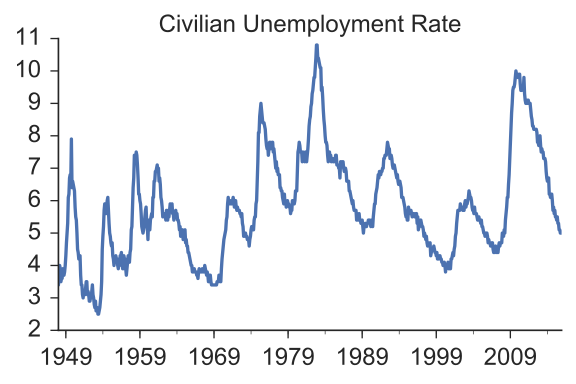
Unemployment Rate Data
Characterized by large, persistent swings upward.
Cycle dominates trend.
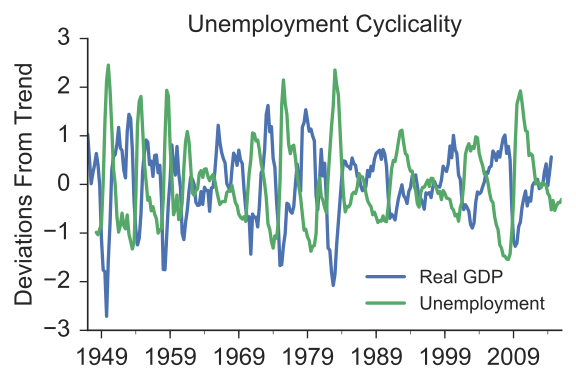
Cyclicality of Unemployment
Clearly countercyclical (goes up when GDP goes down)
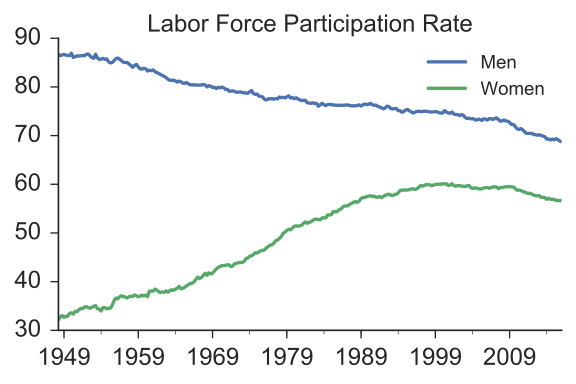
Labor Force Participation Rate
Grew by $\sim 10\%$ between 1960 and 2000, falling thereafter.
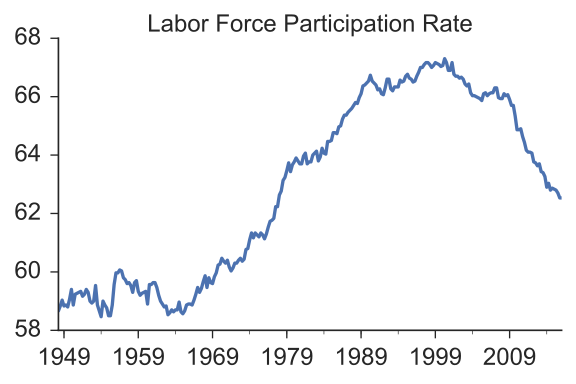
Demographic Causes
Trends in age (baby boom) and
gender (women entering work force)
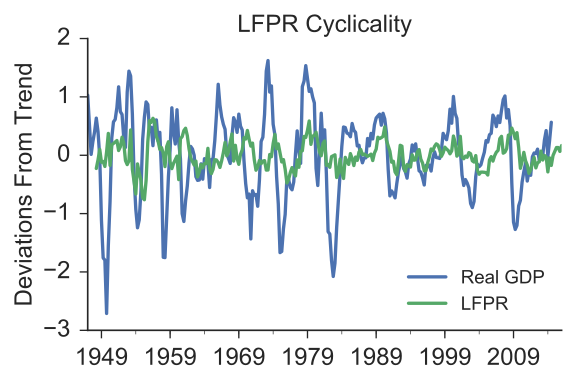
Cyclicality of LFPR
Procyclical (goes up when GDP goes up)
but less volatile and slightly lagging
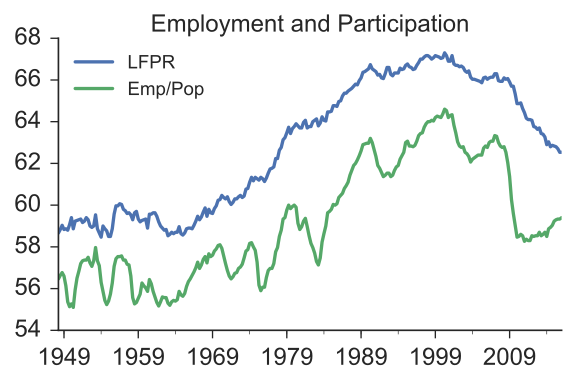
LFPR vs. Empl/Population
Employment/population much less cyclically volatile
Labor Market Dynamics
- Difference between level and "churn"
- Lose your job every week, take one week to find another
- Lose your job every month, take one month to find another
- Both have 50% unemployment (think about it), but first one has more movement/churn
Firm Side Perspective
- To hire workers firms post job openings or "vacancies" ($A$)
- Workers (potentially) reply to these and firms (potentially) hire someone
- Vacancy rate = $\frac{A}{A+E}$, fraction of vacancies that are filled, analogous to unemployment rate
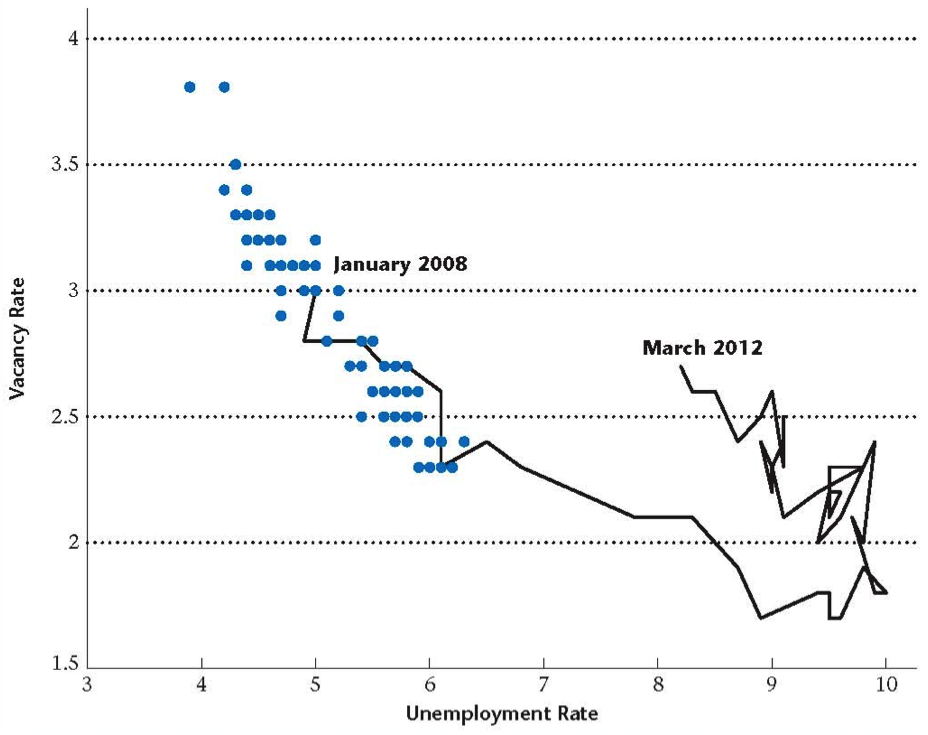
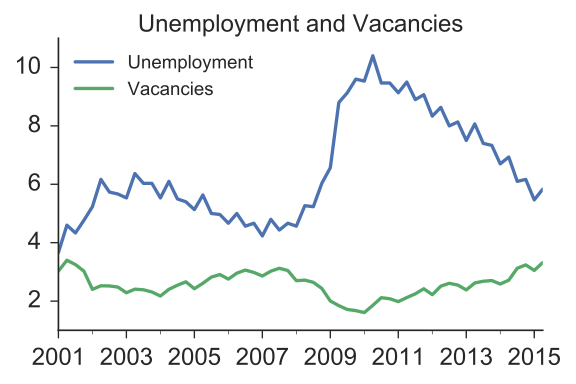
Vacancies in the Data
Vacancies are negatively correlated with unemployment rate (hence procyclical)
What is Unemployment?
- People want to work, but they can't find anyone to hire them
- This means we can't use standard Walrasian model
- Supply $\ne$ Demand
- Why can't people find jobs?
- What happens to people who don't find jobs?
- How does this affect wages and job postings?
A Model of Unemployment
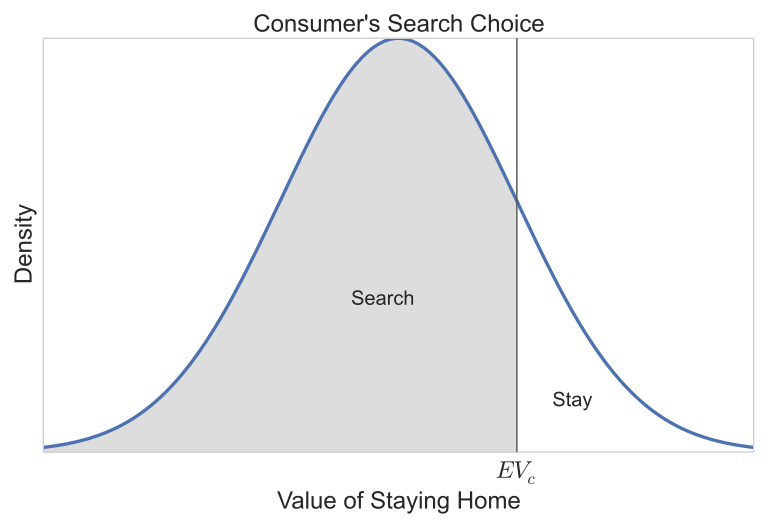
- Workers can either stay at home or search for work
- Staying at home gives some value $s_i$ to worker $i$, unemployment benefits are $b$
- There are $N$ workers in the economy, of which $Q$ are out searching for jobs
- Supposing the distribution of $s_i$ is $F(\cdot)$ and the expected value of searching is $EV_c$, then $$Q = N \cdot F(EV_c)$$
How Many People Search Vs Stay?
Job Vacancies
- Many firms out there who post $A$ vacancies in total
- Matching function tells us the number of jobs found $$E = e \cdot m(Q,A)$$
- $E$ is the total number of jobs found and $e$ is the efficiency of matching, which may change over time
Properties of the Matching Function
- Constant returns to scale $$m(xQ,xA) = x \cdot m(Q,A)$$
- Need both consumers and firms $$m(0,A) = m(Q,0) = 0$$
- Increasing in both arguments, $m_Q \gt 0$ and $m_A \gt 0$
- Decreasing individual returns $m_{QQ} \lt 0$ and $m_{AA} \lt 0$
The Worker's Perspective
- Probability of finding a job, with $j = A/Q$ $$p_c \equiv \frac{E}{Q} = \frac{e \cdot m(Q,A)}{Q} = e \cdot m(1,A/Q) \equiv e \cdot m(1,j)$$
- Workers get wage $w$ if employed, so their expected value of searching is $$EV_c(j) = p_c w + (1-p_c) b = b + e \cdot m(1,j) (w-b)$$
- Consistency requires that $Q = N \cdot F(EV_c(j))$
The Firm's Perspective
- Probability of finding a worker to hire $$p_f \equiv \frac{E}{A} = \frac{e \cdot m(Q,A)}{A} = e \cdot m(Q/A,1) = e \cdot m(1/j,1)$$
- Workers generate $z$ profits to the firm, so their expected value of posting a vacancy is $$EV_f(j) = e \cdot m(1/j,1) (z-w)$$
- A vacancy costs $k$, so we need $k = EV_f(j)$
Wage Determination
- What happens when you actually find a job? No market wage, need to negotiate
- The productivity of the worker $z$ and their available outside benefits $b$ will be important here
- Worker would never accept $w \lt b$ and firm would never pay $w \gt z$, so it will always be between the two $$b \le w \le z$$
- So then we'll say that wage is some linear combination $a$ $$w = az + (1-a) b$$
Putting it all Together
- The two equations characterizing the equilibrium are then $$\begin{align*} \text{Firm:} \ \quad k &= e \cdot m(1/j,1) (1-a) (z-b) \\ \text{Worker:} \quad Q &= N \cdot F(b + e \cdot m(1,j) a (z-b)) \end{align*}$$
- First equation gives us $j$, higher $j = A/Q$ leads to more competition for workers, and lower firm profits
- Using this $j^{\ast}$ second equation gives us $Q$, higher $j$ means more jobs per worker, so more job seekers
Mapping to the Data
- We can express everything of interest using $j$, so unemployment $$\begin{align*} u &= \frac{Q-E}{Q} = 1 - e \cdot m(1,j) \\ v &= \frac{A}{A+E} = \frac{1}{1+e \cdot m(1/j,1)} \end{align*}$$
- Total output (GDP) = output/worker X number of matches $$Y = z \cdot E = z \cdot e \cdot m(Q,A) = z \cdot e \cdot Q(j) m(1,j)$$
- Movements in $j$ will generate negative correlation between output $Y$ and unemployment $u$
A Specific Matching Function
- Those properties look familiar, we can actually just use Cobb-Douglas $$m(Q,A) = Q^{\beta} A^{1-\beta}$$
- We're interested in $$m(1,j) = j^{1-\beta} \qquad\text{and}\qquad m(1/j,1) = j^{-\beta}$$
A Specific Matching Function
- Plugging this into our equilibrium equations $$j^{\ast} = \left[\frac{e(1-a)(z-b)}{k}\right]^{1/\beta}$$
- And the economic outcomes $$u = 1 - e \left[\frac{e(1-a)(z-b)}{k}\right]^{\frac{1-\beta}{\beta}}$$
A Change in Benefits
- In creasing $b$ leads to an increase in wage $w = az + (1-a)b$
- Now there are too many vacancies being posted, firms scale back vacancies per worker $j$
- When $j$ falls and $b$ rises, $Q$ can either rise or fall
- So lower probability of finding a job, but higher value of unemployment
Welfare Effects
- What are true effects of unemployment benefits changes?
- Difficult to test because unemployment benefits generally go up in bad times, when unemployment goes up for other reasons (like $z$ falling)
- Workers are also insured against job loss, which as we learn in micro is a good thing
- Optimal policy should balance unemployment effects with insurance gains
A Change in Productivity
- We only ever see $z-b$, so we know the story for decreasing $z$ is the same as increasing $b$
- $z$ falls $\rightarrow$ $(z-w)$ falls $\rightarrow$ $j$ falls $\rightarrow$ $u$ rises
- There is no countervailing force here, clearly a fall in productivity is bad for welfare
A Change in Match Efficiency
- Fall in match efficiency $e$ has a similar effect: unemployment goes up and output goes down
- We can observe this in the relationship between the unemployment rate $u$ and the vacancy rate $v$ $$j = \left(\frac{1-u}{e}\right)^{\frac{1}{1-\beta}} \rightarrow v = \frac{1}{1 + \left[\frac{e}{(1-u)^{\beta}}\right]^{\frac{1}{1-\beta}}}$$
- Negative relationship between $u$ and $v$ called Beveridge curve
Beveridge Curve Shifts Out
This can be rationalized by a decrease in match efficiency $e$